Advanced Techniques for R/C Racing Setups: Advanced Racing Setup Tips
- Lucas Milton
- May 12
- 4 min read

Setting up a nitro R/C car for racing demands precision and expertise. Every adjustment affects performance, handling, and reliability. I focus on advanced techniques that push the limits of your vehicle. This guide covers suspension tuning, engine optimization, tire selection, and aerodynamic adjustments. I share actionable steps to help you gain an edge on the track.
Mastering Suspension for Peak Performance
Suspension tuning is critical for controlling your car’s behavior on different surfaces. I start by adjusting the shock absorbers. Use oil with the right viscosity to control rebound and compression rates. Thicker oil slows down shock movement, improving stability on rough tracks. Thinner oil allows quicker response on smooth surfaces.
Next, I adjust spring rates. Softer springs improve traction but reduce responsiveness. Stiffer springs increase cornering speed but can cause loss of grip. I recommend testing different spring combinations to find the balance that suits your track conditions.
Ride height also plays a major role. Lowering the chassis reduces the center of gravity, improving cornering. However, too low a ride height risks bottoming out on bumps. I adjust ride height incrementally and test for consistent ground clearance.
Finally, I fine-tune camber and toe angles. Negative camber increases tire contact during cornering, enhancing grip. Toe-in improves straight-line stability, while toe-out enhances turn-in response. I use small adjustments and test laps to dial in the best settings.
Advanced Racing Setup Tips for Engine and Fuel Management
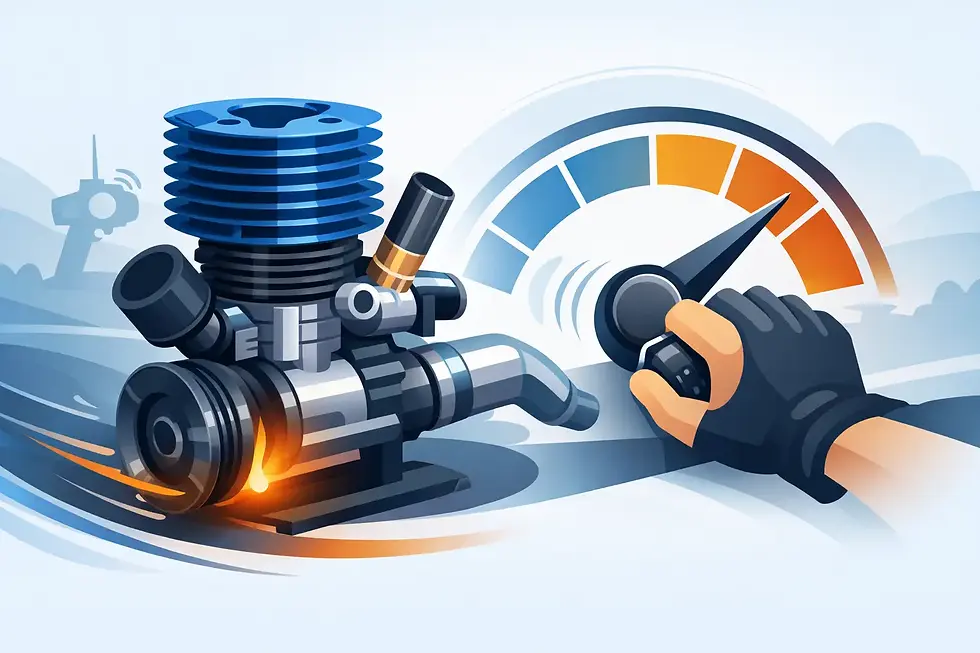
Engine tuning is the heart of nitro R/C racing. I focus on optimizing the carburetor settings for maximum power and reliability. Start by adjusting the high-speed needle to control fuel flow at full throttle. Leaning the mixture increases power but risks overheating. Richening the mixture improves cooling but reduces top speed.
I also adjust the low-speed needle for smooth throttle response. A well-tuned low-speed needle prevents stalling and hesitation during acceleration out of corners. I recommend making small adjustments and running the engine at operating temperature before finalizing settings.
Fuel choice impacts performance. I use high-quality nitro fuel with the right blend of nitromethane, oil, and methanol. Higher nitro content increases power but demands more precise tuning and cooling. I monitor engine temperature closely to avoid damage.
Glow plug selection affects ignition and throttle response. I test different heat ranges to find the plug that provides consistent firing under race conditions. An O.S. RP6 or RP7 are my choice plugs. A plug that is too hot causes pre-ignition, while one that is too cold leads to poor combustion.
Optimizing Tires and Traction for Competitive Edge
Tire selection and preparation are vital for grip and handling. I choose tires based on track surface and weather conditions. Soft compound tires offer superior traction on smooth, dry tracks but wear quickly. Harder compounds last longer and perform better on abrasive or wet surfaces.
I prepare tires by cleaning and scuffing the surface to improve grip. Using fine sandpaper or a tire truer helps remove mold release agents and smooth out imperfections. I also apply tire traction compounds sparingly to enhance stickiness without causing excessive wear.
Tire pressure affects contact patch and handling. I adjust pressure to balance grip and rolling resistance. Lower pressure increases traction but can cause tire deformation and slower response. Higher pressure reduces rolling resistance but decreases grip.
Wheel alignment impacts tire wear and handling. I check for proper balance and true wheels to prevent vibrations and uneven wear. I also ensure wheel nuts are tightened to the correct torque to avoid loosening during races.
Aerodynamics and Weight Distribution for Stability
Aerodynamics influence high-speed stability and cornering. I add adjustable wings and spoilers to increase downforce. More downforce improves tire contact and grip but increases drag, reducing top speed. I test different wing angles to find the optimal balance.
Weight distribution affects handling and traction. I position heavy components like the fuel tank and battery to lower the center of gravity and centralize mass. This improves cornering stability and reduces body roll.
I also use ballast weights strategically to fine-tune balance. Adding weight to the front improves steering response, while rear weight enhances traction on acceleration. I adjust weight placement based on track layout and surface conditions.
Chassis stiffness impacts handling precision. I reinforce the chassis with braces or upgrade to stiffer materials to reduce flex. A stiffer chassis provides consistent handling feedback and improves cornering accuracy.
Data-Driven Adjustments and Testing Protocols
Consistent testing and data collection are essential for refining setups. I use lap times, tire wear, and engine temperature data to evaluate changes. I recommend keeping a detailed log of setup parameters and track conditions.
I perform controlled tests by changing one variable at a time. This isolates the effect of each adjustment. I run multiple laps to ensure results are consistent and not affected by external factors.
Video analysis helps identify handling issues and driving lines.
Continuous Improvement for Competitive Advantage
Achieving peak performance requires ongoing refinement. I regularly revisit setup parameters to adapt to changing track conditions and competition. I stay informed about new technologies and techniques in the nitro R/C racing community.
I emphasize patience and methodical testing. Quick fixes rarely yield lasting results. Instead, I focus on incremental improvements supported by data.
By mastering these advanced techniques, you can maximize your car’s potential. Precision setup leads to faster lap times, improved reliability, and greater confidence on the track. This approach aligns with the goal of achieving peak engine performance and reliability through professional, data-driven methods.