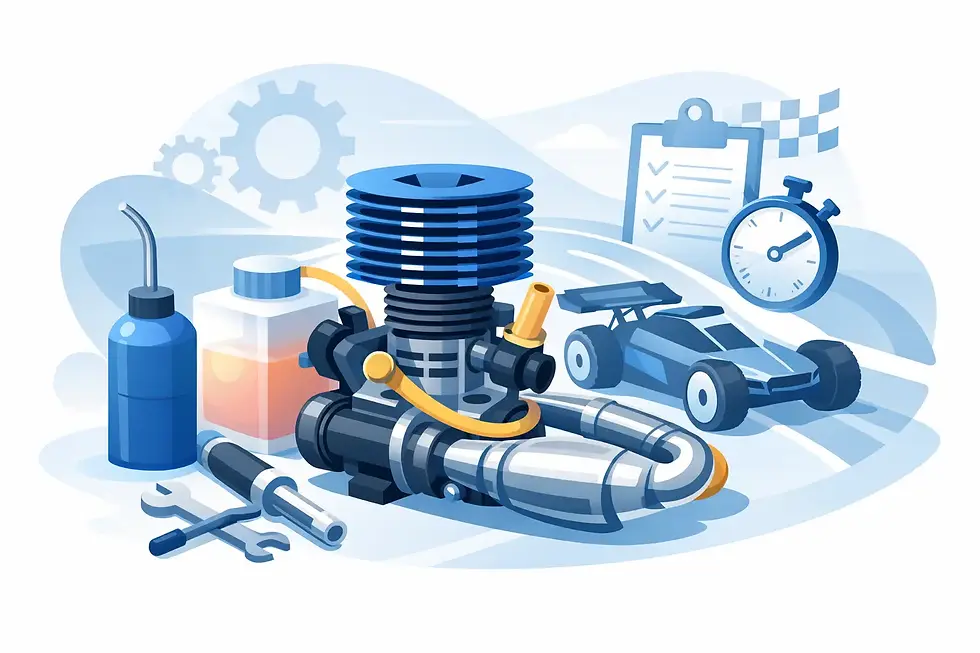
Data-Driven Nitro Engine Tuning Insights for Peak Performance
- Lucas Milton
- Apr 14
- 3 min read

Updated: May 7

Tuning a nitro engine for an R/C car is a precise task. It requires more than just guesswork or trial and error. Using data to guide tuning decisions can make a big difference in performance and reliability. I’ve seen how data-driven approaches help racers get the most out of their engines. This post shares insights on how to use data effectively for nitro engine tuning.
Understanding the Basics of Nitro Engine Tuning
Nitro engines run on a mix of nitromethane, methanol, and oil. The tuning process adjusts the fuel and air mixture to get the right combustion. The goal is to maximize power while keeping the engine safe from damage.
Key tuning points include:
High-speed needle: Controls fuel at high RPMs
Low-speed needle: Controls fuel at low RPMs
Idle speed: Adjusts the engine’s idle RPM
Tuning affects how the engine responds to throttle input, how smoothly it runs, and how long it lasts. Without proper tuning, the engine can run too lean (too little fuel) or too rich (too much fuel), causing overheating or poor performance.
Why Data Matters in Nitro Engine Tuning
Traditionally, tuning relied on sound, feel, and experience. While these are important, they can be subjective. Data adds objectivity. It shows exactly how the engine performs under different conditions.
Using data helps to:
Identify the best needle settings for different tracks and weather
Detect engine issues early before they cause damage
Compare performance changes after adjustments
Fine-tune for consistent lap times and power output
For example, logging engine temperature, RPM, and exhaust gas readings can reveal if the engine runs too hot or if the fuel mixture is off. This information guides precise adjustments.
Tools That Support Data-Driven Tuning
Several tools make data-driven tuning possible. Examples of these are the MiniPro engine dyno and MiniPro chassis dyno. These devices measure all data necessary in real time. It provides clear data to help tune the engine accurately.
MiniPro Software is the best by far.-made specifically for R/C vehicles. It's not a MacGyver'd system to be able to use R/C platforms. MiniPro logs all data at any selected frequency, you can review graphs and spot trends that are hard to detect by ear alone. High frequency can spot engine, clutch, and drivetrain inconsistencies before they become catastrophic issues. Lower frequency records the true power and torque curves.
Using these tools together lets you build a tuning profile for each engine and track condition. This approach reduces guesswork and improves results.
How to Use Data for Effective Tuning
Start by setting a baseline. Run the engine with standard settings and record data. Note RPM, temperature, and how the engine sounds.
Next, make small adjustments to the high-speed or low-speed needles. After each change, record data again. Look for:
Stable RPM at full throttle
Engine temperature within safe limits (usually 210-250°F)
Smooth acceleration without hesitation
If the engine runs hotter or RPM drops, the mixture might be too lean. If the engine bogs down or smokes, it’s likely too rich.
Use the data to find the sweet spot where the engine runs strong and stays cool. Repeat this process for different track conditions.
Real-World Example of Data-Driven Tuning Success
A racer I worked with struggled with inconsistent lap times. The engine would overheat on some runs and bog on others.
The data showed the high-speed needle was set too lean for the hot afternoon runs. Adjusting it richer improved engine temperature and power. The racer’s lap times became more consistent, and the engine lasted longer without issues.
This example shows how data can solve tuning problems that are hard to detect by feel alone.

Tips for Maintaining Engine Health with Data
Data-driven tuning also helps protect your engine. Watch for signs like:
Sudden spikes in temperature
Unusual RPM drops
Increased vibration
These can indicate problems like clogged fuel lines, worn glow plugs, or air leaks. Catching issues early prevents costly repairs.
Regularly logging data builds a history of your engine’s performance. This history helps predict when maintenance is needed.
Final Thoughts on Data-Driven Nitro Engine Tuning
Using data to tune nitro engines changes the game. It removes guesswork and gives clear feedback.
By tracking key metrics and adjusting based on facts, you can improve engine power, reliability, and consistency. This method helps you get the most from your nitro R/C car on every run.
Get a complete race optimization today and see how it transforms your vehicle. The results speak for themselves.