
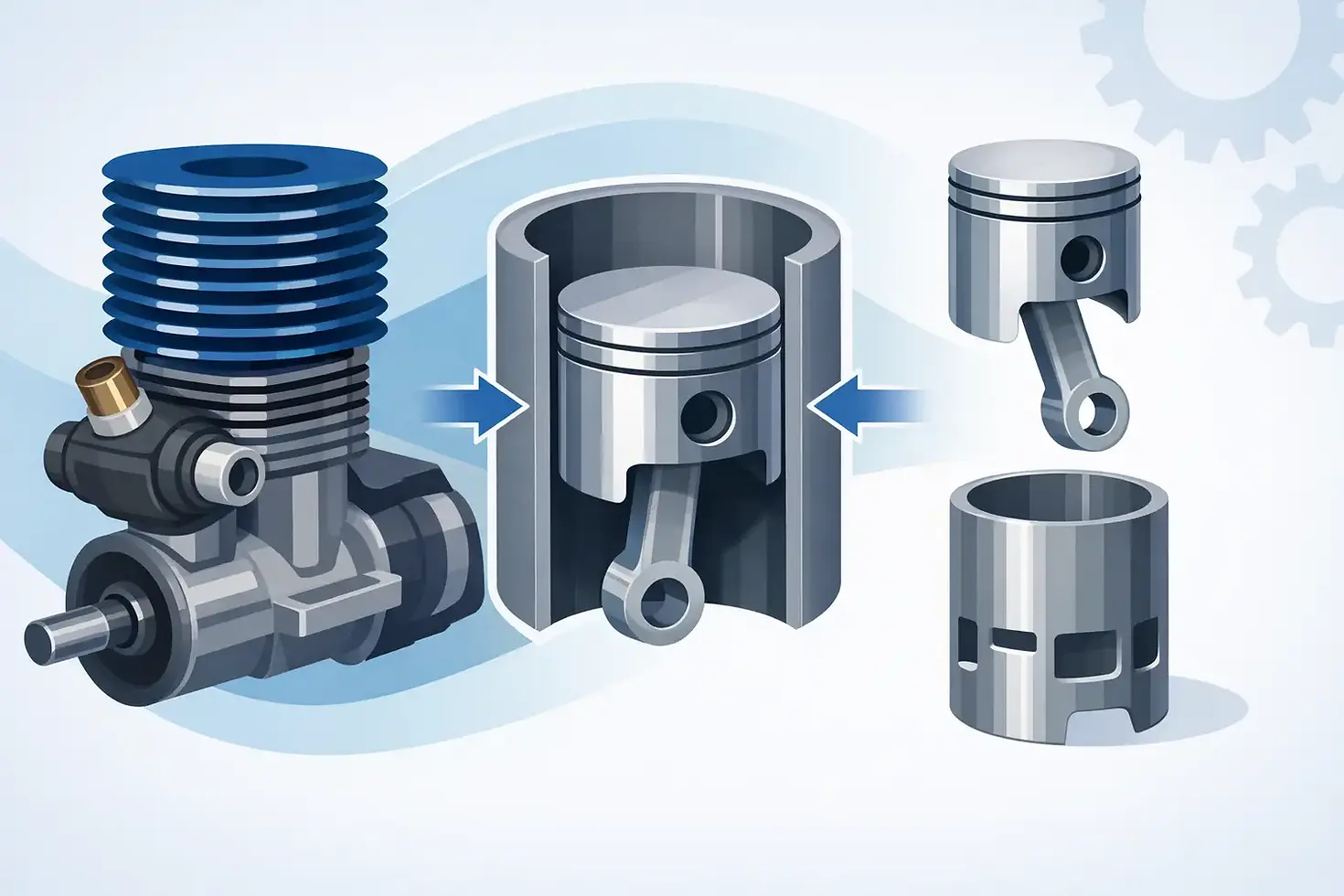
Piston-to-Sleeve Nitro Engine Fit Explained
A piston to sleeve nitro engine fit is not a minor assembly detail. It is the mechanical relationship that determines how consistently the engine seals compression, carries load, responds to needle changes, and survives heat cycles. When that relationship is wrong, no amount of casual tuning will create predictable race-day performance.
In a healthy nitro R/C engine, the piston, sleeve, fuel system, combustion process, and operating temperature work as one system. The piston-to-sleeve interface is central to that system. It must create effective compression at operating temperature without excessive friction, scuffing, or unstable sealing. Performance is measured, not guessed.
What Piston-to-Sleeve Fit Actually Controls
Most performance nitro engines use an aluminum piston running in a brass sleeve with a hard nickel or chrome-based bore surface. The sleeve is manufactured with a controlled taper near the top of the bore. That upper area creates the tight condition commonly called pinch.
Pinch is not simply resistance when the piston reaches top dead center. It is a designed sealing zone that changes as the engine heats. Aluminum expands at a different rate than the sleeved bore, so a fit that feels firm when cold can become correct and efficient at operating temperature. Conversely, a fit that feels loose cold may become marginal under load, especially once the engine is fully heat-soaked.
That fit influences four race-relevant outcomes:
Compression stability through the heat cycle
Low- and midrange throttle response
Fuel-metering sensitivity and tune consistency
Service life under repeated loaded operation
A tight piston-to-sleeve relationship can produce strong compression and crisp response, but only if it is broken in correctly. Excessive cold tightness, improper lubrication, lean operation, or aggressive early loading can damage the sealing surfaces before they establish a stable operating pattern. A worn or poorly matched fit can make an engine easier to turn over, but it may also produce weak launches, inconsistent needle behavior, and reduced recovery out of corners.
Why a New Engine Needs Controlled Load
A new piston and sleeve do not need endless idle time. They need controlled temperature, lubrication, and load. Bench idling often creates heat without providing the operating forces that help the piston and sleeve establish their working relationship. It can also leave the engine excessively rich, poorly cooled in certain areas, and far removed from the conditions it will see on track.
Controlled-load break-in applies measured operating demand while monitoring engine behavior. The objective is not to force the engine through a tight spot. The objective is to bring the assembly through repeatable heat cycles while confirming that fuel delivery, temperature, compression behavior, and throttle response remain within a safe and productive range.
The correct approach depends on the engine platform, fuel blend, ambient temperature, drivetrain load, and intended use. A .21 off-road race engine prepared for repeated acceleration and braking will not behave exactly like an on-road engine held at sustained high rpm. The principle remains the same: break-in should establish a usable seal under representative load, not merely accumulate run time.
Tight Is Not Always Better
Racers often judge piston-to-sleeve condition by how much resistance they feel turning the flywheel. That observation can be useful, but it is not a complete diagnosis. A firm top-of-stroke feel may indicate healthy pinch. It can also be influenced by oil film, residual fuel, connecting rod condition, combustion deposits, or the engine's temperature.
An engine can feel tight yet run poorly if the sleeve is distorted, the piston is scuffed, the crankshaft bearings are failing, or the fuel system is delivering inconsistently. It can also feel relatively free when cold and still make stable power once it reaches operating temperature. Mechanical feel is a starting point, not verification.
Too much interference at the piston-to-sleeve interface creates trade-offs. Friction rises. Starting load rises. The engine may struggle to reach a clean temperature window, particularly with a conservative break-in tune. If it is leaned prematurely to make it feel sharper, the result can be scoring, localized heat damage, or shortened life.
Too little effective fit creates a different set of problems. The engine may lose compression stability as temperature increases. Low-end response softens, tune settings become more sensitive, and the engine can feel inconsistent from one run to the next. A driver may keep chasing needles when the actual limitation is mechanical sealing.
Signs the Piston and Sleeve Need Evaluation
A loss of performance is not automatically a piston-and-sleeve problem. Clutch condition, exhaust pressure, tank seals, fuel line condition, bearings, plug performance, and carburetor settings can all produce similar symptoms. That is why system-level diagnosis matters.
Still, piston-to-sleeve condition should be evaluated when an engine develops a persistent combination of weak bottom-end pull, reduced compression feel, difficult hot restarts, unstable tune behavior, or a noticeable drop in runtime performance. Visible aluminum transfer, vertical scoring, discoloration, or abnormal witness marks inside the sleeve also justify inspection.
The critical distinction is between normal seating and actual damage. A properly run engine will show evidence of use. That does not mean it requires replacement. The question is whether the contact pattern supports stable compression and predictable operation under load.
A useful evaluation considers more than the sleeve bore. The piston crown, skirt, rod fit, wrist pin, crankshaft, bearings, combustion chamber, and fuel delivery must be assessed together. Replacing a piston and sleeve without identifying the cause of the previous failure can repeat the problem quickly. A lean fuel condition, air leak, bearing debris, poor filtration, or incorrect break-in procedure can damage a new assembly just as effectively as the old one.
How Controlled Testing Separates Condition From Opinion
A controlled-load test provides information that hand-turning and bench running cannot. Under measured load, an engine reveals whether it can hold a stable tune through acceleration, maintain usable compression as temperature changes, and transition cleanly across the powerband.
The process begins with baseline mechanical and fuel-system checks. From there, operating behavior can be observed through warm-up, loaded acceleration, sustained rpm, and recovery. The goal is not a single peak number. A race engine needs repeatable output, stable response, and a tune window that does not collapse when track conditions change.
For example, an engine with a worn sleeve may initially sound clean with an aggressive needle setting, then lose response as it heat-soaks. An engine with excessive friction may seem flat while rich, but show rapid temperature rise when leaned enough to make power. Both conditions can be misdiagnosed through casual tuning. Controlled testing identifies the pattern before corrective work is recommended.
That transparency matters. If inspection identifies a damaged piston and sleeve, the next step should be clear: explain the finding, identify likely contributing factors, and recommend the corrective action before additional work proceeds. Powerband Precision applies this discipline because tuning should validate engine condition, not conceal an unresolved mechanical issue.
Protecting Piston-to-Sleeve Life After Service
Once an engine has established stable piston-to-sleeve fit, consistency comes from disciplined operation. Use clean, properly stored fuel. Maintain effective air filtration. Verify that pressure lines, tank seals, and fuel lines are sound. Avoid tuning by sound alone, especially when ambient conditions or track load have changed.
Do not treat a brief high-rpm pass as proof that the engine is healthy. The meaningful question is whether it remains clean, responsive, and stable through a complete loaded run. A tune that appears fast for one lap but overheats or fades by the main is not a performance tune.
After a hard run, allow the engine to cool naturally rather than forcing rapid cooling. Keep after-run maintenance practical and consistent, especially if the engine will sit for an extended period. More importantly, investigate changes early. A new hesitation, altered compression feel, unexplained temperature shift, or narrowing tune window is data. Address it before minor wear becomes an expensive failure.
The best piston-to-sleeve setup is not the one that feels tightest on the bench. It is the one that delivers stable compression, predictable throttle response, and repeatable power under the load your engine actually sees.


