
Controlled Load Nitro Engine Break-In Explained
A new nitro engine can feel strong on the bench and still become inconsistent once it sees real track load. That gap is exactly why controlled load nitro engine break-in matters. Break-in is not a ritual of rich idle tanks or a vague promise to “let it loosen up.” It is the controlled conditioning of the piston, sleeve, connecting rod, bearings, and fuel system through the heat and resistance the engine will actually encounter.
For a racer, the goal is not simply to get through the first few tanks without damage. The goal is to establish stable compression, predictable fuel demand, clean throttle response, and a powerband that remains usable through a race distance. Performance is measured, not guessed.
What Controlled-Load Break-In Actually Does
A nitro racing engine leaves the factory with an intentionally tight piston-to-sleeve fit. That pinch is a major part of its compression seal. During break-in, the piston and sleeve must mate under carefully managed temperature, lubrication, RPM, and load conditions. The process creates a working fit that seals effectively without scuffing, overheating, or prematurely reducing compression.
Bench idling applies heat, but it applies very little meaningful load. The engine may run rich and cool enough to survive, yet the piston, sleeve, and rotating assembly are not being conditioned through the changing forces of acceleration and sustained RPM. The result can be an engine that appears broken in but has not established a stable operating relationship under the conditions that matter on the track.
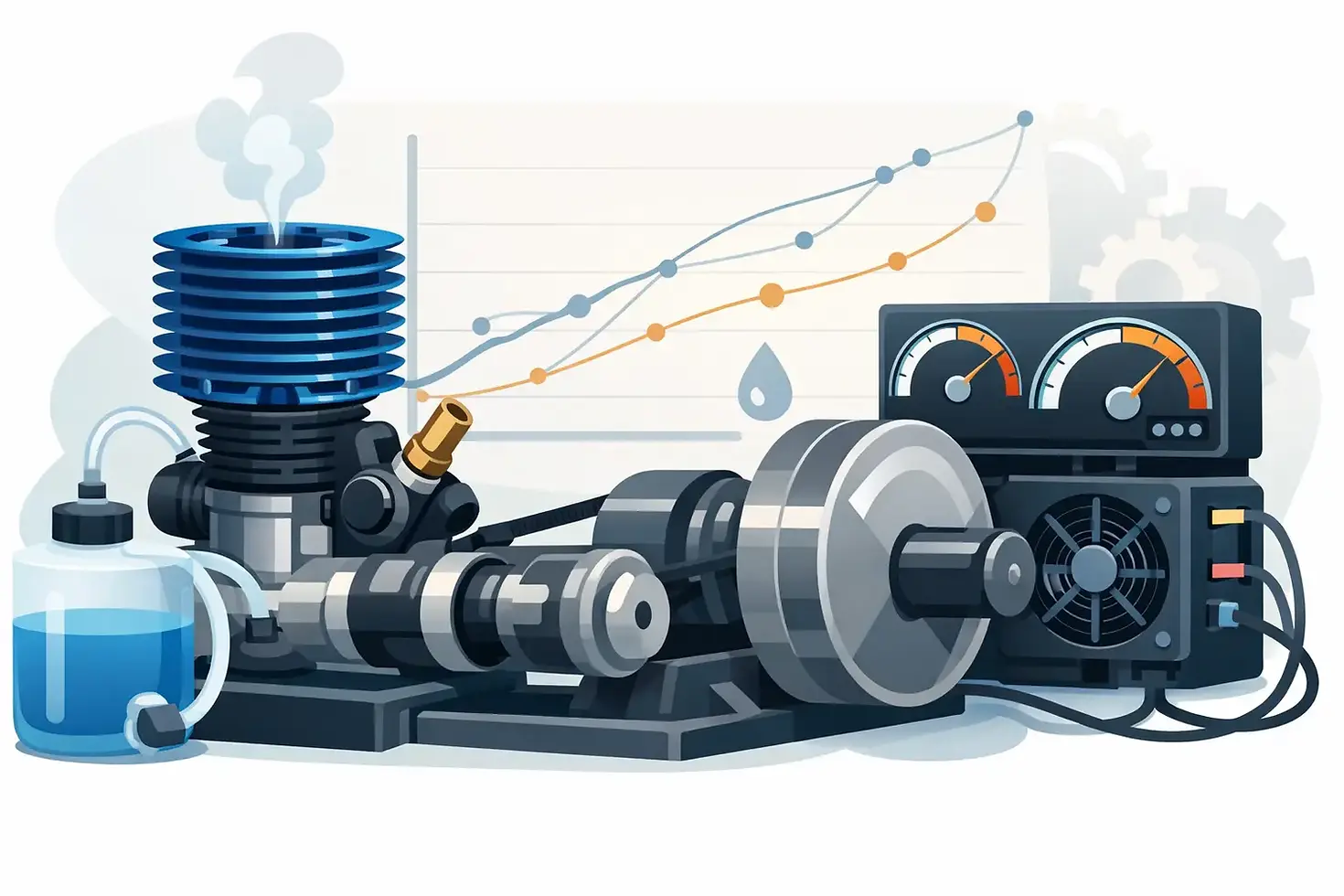
Controlled load testing changes that. The engine is run through measured operating ranges with resistance applied in a repeatable way. Fuel delivery, head temperature trend, RPM behavior, exhaust response, and compression characteristics can be observed together. Rather than treating break-in as a single setting, the process evaluates the engine as a system.
That distinction matters because a rich needle setting is not automatically a safe setting. Excess fuel can provide lubrication and cooling, but an engine that is too rich may struggle to clear itself, load inconsistently, and cycle temperature unpredictably. Conversely, leaning an engine simply to make it sound crisp can create excessive heat before the piston and sleeve have stabilized. Controlled break-in is about maintaining the correct operating window, not chasing a fixed sound, smoke trail, or temperature number.
Why Idle-Only Break-In Falls Short
Idle-only break-in persists because it feels cautious. The engine is not being driven hard, so the method appears low risk. The problem is that low risk and low information are not the same thing.
At extended idle, combustion is often incomplete, crankcase loading is minimal, and airflow through the cooling head does not resemble a moving vehicle. The engine may spend long periods four-stroking, loading with excess fuel, and responding slowly to needle changes. Those conditions reveal little about how the engine will behave when it transitions from a corner exit into sustained acceleration.
A racing engine also does not live at one RPM. It must recover from low-speed transitions, carry load through the midrange, and continue pulling cleanly at the top end. Break-in that never exposes those transitions leaves critical behavior unverified. A racer may then spend the first practice day trying to correct what is actually an unstable break-in condition with clutch changes, pipe swaps, or needle adjustments.
There is a trade-off. A controlled-load process must be disciplined. Too much load too early can raise friction and heat before adequate piston-to-sleeve mating has occurred. Too little load for too long can delay stabilization and disguise a fuel-delivery or assembly issue. The correct progression depends on engine platform, displacement, bearing condition, fuel, plug selection, ambient conditions, and intended use.
The Measurements That Matter During Break-In
Useful break-in data is not limited to peak RPM. Peak output may be interesting, but it does not tell the full story of whether an engine will hold a reliable tune during a main.
Compression Behavior
Compression should develop and stabilize through the process. An engine with healthy pinch will show a consistent feel and operating response as temperature rises. If compression behavior is weak, erratic, or deteriorates quickly, the cause may be more complex than normal wear. Piston and sleeve condition, bearing contamination, improper assembly, air leaks, or previous overheating can all affect the result.
Fuel Delivery and Needle Response
Needle settings work as part of a fuel system, not as isolated adjustments. Tank pressure, fuel line condition, filter restriction, carburetor sealing, exhaust pressure routing, and ambient air all influence what the engine receives. During controlled operation, the engine’s response to fuel changes should be clear and repeatable. If a small adjustment creates a large, unpredictable change, the correct action is diagnosis, not continued guessing.
Temperature Trend Under Load
A single temperature reading is a snapshot. The more useful question is how temperature moves as load and RPM change. Does the engine stabilize after a pull? Does it spike sharply on transition? Does it remain artificially cool because it is excessively rich, then climb once the mixture clears? These patterns help distinguish normal break-in friction from a tuning, airflow, or mechanical concern.
Throttle Recovery and Powerband Shape
A race engine needs more than top-end speed. It needs a clean, repeatable transition from low RPM to the middle of the powerband, where much of the lap is won or lost. Controlled load allows the evaluator to identify hesitation, excessive loading, delayed pipe engagement, or a flat midrange before the engine is sent back to the track.
A Disciplined Break-In Progression
The process begins with verification, not assumptions. Before extended running, the engine should be inspected for correct assembly, fuel system integrity, suitable plug selection, clutch and driveline condition, and any obvious air-leak risk. Break-in cannot correct a damaged rear bearing, an unstable tank-pressure line, or a clutch that prevents the engine from seeing consistent load.
Initial runs establish lubrication, temperature control, and basic fuel response. The engine is not held at one constant speed. It is brought through short, controlled cycles that allow the assembly to heat, expand, cool, and demonstrate how it responds. Settings remain conservative, but not so rich that combustion becomes unstable and the engine cannot clear under load.
As the engine begins to free up, load duration and RPM range can increase in measured steps. This is where the relationship between compression, fuel demand, and throttle response becomes more visible. The goal is not to force the engine into peak power immediately. The goal is to confirm that it carries load cleanly, returns to a stable condition, and responds predictably to adjustments.
Final verification should reflect the intended application. A truggy, buggy, on-road car, and drag-oriented setup do not load an engine in the same way. Gear ratio, clutch engagement, pipe choice, and vehicle weight all influence operating demand. A useful break-in process accounts for those realities instead of applying one generic procedure to every engine.
When Break-In Reveals a Larger Problem
Not every engine that runs poorly during break-in simply needs more tanks. Persistent inconsistency can indicate a mechanical or system-level issue. Common findings include air leaks, worn or contaminated bearings, poor piston-to-sleeve condition, carburetor sealing problems, damaged fuel tubing, unsuitable plug heat range, or an exhaust pressure issue.
Continuing to run an engine through those symptoms can turn a correctable concern into a costly rebuild. It can also create false confidence. An engine may briefly sound clean after a needle adjustment, then lose consistency as temperature and load expose the underlying problem.
That is why a measurement-first service process is valuable. At Powerband Precision, controlled-load evaluation identifies the engine’s actual behavior and documents recommended corrective action before additional work proceeds. The objective is transparent: establish what is working, identify what is limiting performance, and avoid charging ahead on assumptions.
What Racers Should Expect After Proper Break-In
A properly conditioned engine should not require constant rescue tuning. It should start and clear consistently, hold a stable tune through repeated runs, transition with authority, and retain usable compression over time. Those outcomes do not mean the engine will ignore weather changes or poor fuel maintenance. Nitro engines remain sensitive systems. They do mean the baseline is sound and adjustments can be made from evidence rather than frustration.
There is no universal tank count that guarantees this result. One engine may stabilize quickly, while another needs closer attention because of its platform, fit, previous handling, or supporting components. The standard should be repeatable operating behavior under load, not an arbitrary number of tanks burned.
Treat the first runs of a new engine as the foundation for every lap that follows. Give the piston and sleeve a controlled environment, verify the system around them, and let measurable behavior determine the next adjustment. That is how an engine earns predictable power when the race is on the line.


